
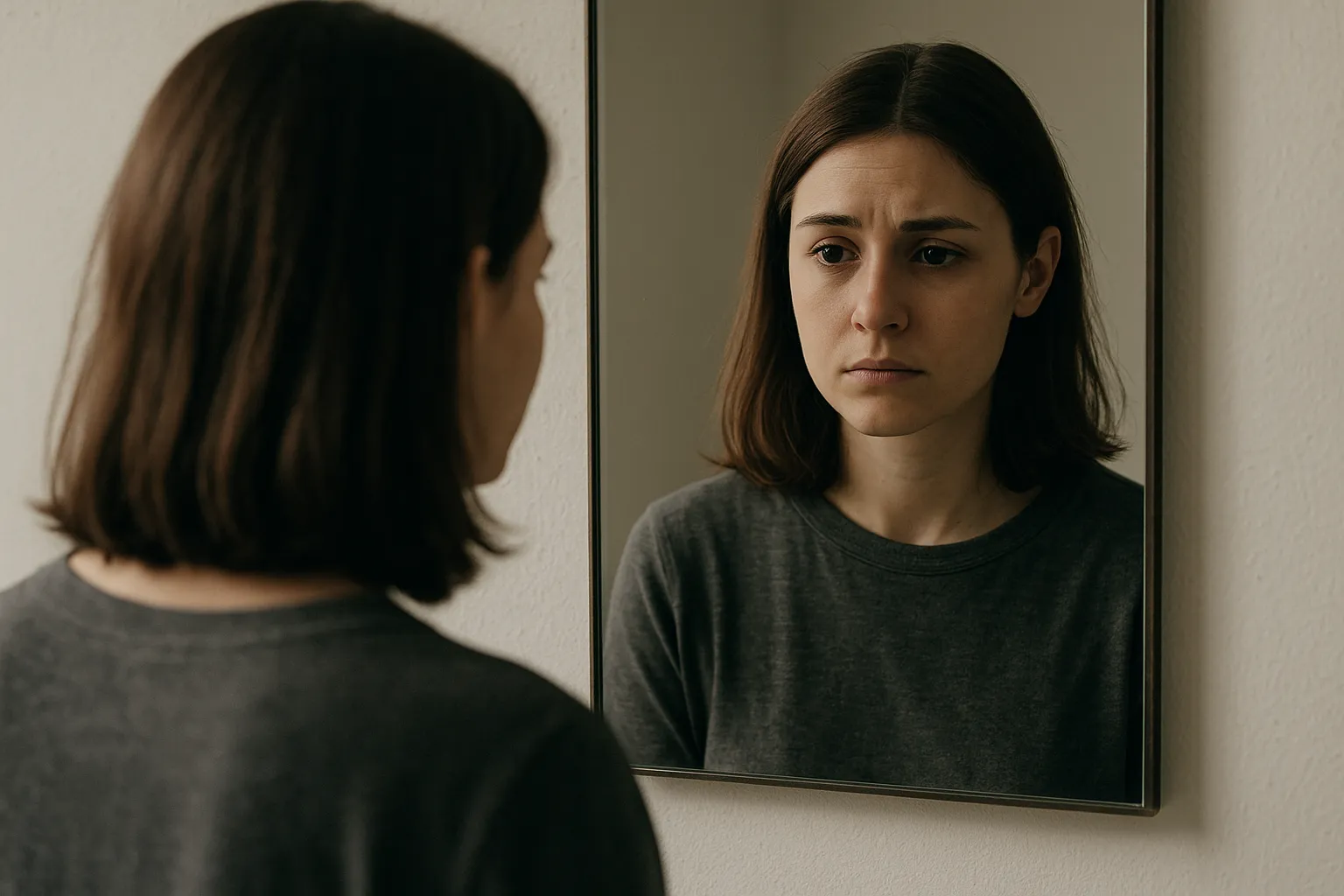
The Reflection I Once Avoided
There was a time when I couldn’t look at my reflection for more than a few seconds.
Not because I hated what I saw, but because I didn’t recognize her. The woman staring back seemed both familiar and distant — a version of me that had endured too much and felt too little. Her eyes carried stories she didn’t tell, her body held tension she pretended not to feel.
I’d glance into the mirror only when necessary — brushing teeth, fixing hair, adjusting a shirt before leaving the house. Always with the same quiet avoidance. I’d focus on the task, not the person. On appearance, not essence.
Somewhere between grief, exhaustion, and the dull ache of routine, I stopped seeing myself as me and started seeing a checklist: aging skin, softening lines, the slow erosion of the woman I thought I was supposed to be.
When the Body Became an Apology
For years, my body was something I apologized for.
Apologized for its changes, for the way time had redrawn its contours, for its insistence on reminding me that I had lived. I apologized for its softness, for the places it refused to tighten, for the way it sometimes felt heavier with memories than with flesh.
Every photograph became an evaluation. Every outfit a test. Every compliment a puzzle I didn’t know how to accept.
It’s strange how easily we absorb the world’s expectations — how we measure beauty not by what feels alive, but by what seems untouched. We praise youth as if it were a virtue, forgetting that every wrinkle is proof we’ve laughed, cried, endured.
The mirror became a battlefield — one I lost daily, quietly, invisibly.
The Moment of Reckoning
It wasn’t a dramatic turning point, no cinematic awakening.
It was a small, ordinary morning. The kind where the light comes through the window just right — soft, honest, unfiltered. I caught my reflection without meaning to, and for once, I didn’t look away.
There she was — tired, yes, but also alive. Eyes framed by years of emotion, shoulders rounded from the weight of responsibility but strong enough to hold herself up. And in that moment, something inside me softened.
I didn’t see flaws; I saw evidence. Evidence of living, of giving, of surviving. Evidence of laughter that left faint creases around my mouth, of nights I stayed awake thinking too much, of mornings I began again even when I didn’t want to.
I realized I didn’t want to erase those marks. I wanted to honor them.
Learning Presence Over Perfection
Loving the mirror again began not with beauty, but with presence.
I started small — meeting my gaze without judgment, touching my skin without critique, thanking my body for carrying me through years of uncertainty.
It felt awkward at first, like speaking a language I had forgotten. But slowly, the sentences returned: You are enough. You are whole. You are here.
Presence became a ritual. Standing before the mirror each morning, I’d breathe deeply, letting the sight of myself feel familiar again. I’d trace the curve of my jaw, the shape of my shoulders, the slope of my stomach — not as imperfections to be corrected, but as geography to be explored.
I stopped comparing my reflection to younger versions of me or to the images curated on screens. I began to see the difference between what is beautiful and what is real — and chose real, every time.
The Body as Memory
Our bodies remember what our minds try to forget.
Every scar is a story; every stretch mark, a timeline. When I began to see my body as a living archive rather than a flawed sculpture, something shifted.
There was the scar near my hip — a reminder of the surgery that saved my health. The freckle on my left shoulder — the one a lover once traced like a secret. The faint silver lines across my skin — not shame, but evidence of expansion, of life growing and shifting.
I started photographing myself again. Not to capture beauty in the traditional sense, but to witness existence. The camera became a mirror that didn’t lie but didn’t judge either. Each image said: This is me, as I am, and that is enough.
Unlearning the Noise
The hardest part of loving the mirror isn’t the mirror — it’s the noise around it.
The endless messages about what we should be, how we should look, how youth is currency and aging a failure. I had to learn to turn down that noise until all that remained was the quiet sound of my own breath.
I stopped following accounts that made me feel less-than. I stopped asking people who didn’t know my story to validate my worth. Instead, I sought stillness — a space where my reflection and I could exist without commentary.
And in that stillness, I found clarity. The mirror wasn’t my enemy. My reflection was never the problem. It was the lens I had been told to use — the one that measured rather than celebrated.
The Return of Desire
With acceptance came something unexpected — desire.
Not the kind directed outward, but inward. A quiet, humming desire to feel alive in my own skin again. To stretch, to move, to touch. To inhabit my body fully instead of observing it from a distance.
Desire, I realized, isn’t vanity. It’s vitality. It’s the spark that says, I’m still here.
I started dressing for sensation rather than approval — fabrics that felt soft against my skin, colors that matched my mood, clothes that made me feel like myself. I wore lipstick for no reason other than to see color bloom back into my face.
Some mornings, I danced alone in front of the mirror. Not to perform, but to reconnect — to remind my reflection that we are partners, not opponents.
The Mirror as Witness
The mirror doesn’t judge; it reflects.
It has seen me through grief, joy, exhaustion, and rebirth. It’s watched tears fall and smiles return. It knows more of my truth than anyone else ever will.
Now, when I stand before it, I try to meet that truth with gratitude. Not every day feels easy — some mornings I still flinch at my reflection, still see echoes of old insecurities. But even those moments feel softer now, less cruel, more human.
A Conversation with Time
Time has a way of showing itself quietly.
Not in sudden transformations but in subtleties — the deepening of a smile line, the softening of a curve, the way your hands look more like your mother’s every year. For a while, I feared those traces. I thought they meant loss — of youth, of desirability, of belonging to a world obsessed with beginnings.
But now, I see time as a collaborator.
Each year paints me a little wiser, a little braver, a little more myself. My reflection tells the truth time has written across my skin, and rather than wishing it away, I’ve learned to read it like poetry.
The mirror doesn’t show what’s gone. It shows what remains — and what continues to grow.
The Art of Acceptance
Acceptance isn’t passive. It’s an act of rebellion.
In a culture that thrives on dissatisfaction, choosing to love your reflection is radical. Every time I look at myself and say, this is enough, I push back against an entire industry built on convincing me otherwise.
But acceptance isn’t linear. There are mornings when I wake feeling whole and beautiful, and others when I catch my reflection and feel the old shame creeping back. The difference now is that I don’t run from it. I breathe through it. I remind myself that love is not erased by doubt — it deepens through it.
I’ve stopped waiting for perfect days to feel worthy. Worthiness is not a reward for effort; it’s the foundation I build everything else upon.
The Mirror as Teacher
Every reflection teaches something if you’re willing to look long enough.
I’ve learned patience — the kind that comes from watching myself heal slowly. I’ve learned forgiveness — especially for the times I didn’t know how to love myself. And I’ve learned honesty — the courage to face what’s really there, not what I wish I could see.
The mirror has shown me that strength isn’t just about resilience. Sometimes, strength looks like softness. It looks like standing bare-faced, unguarded, unfiltered, and saying, This is who I am today.
It’s not about approval anymore. It’s about truth — and truth, I’ve discovered, is far more beautiful than perfection.
The Sensual Self
There’s a kind of magic in learning to see your body as a source of pleasure rather than judgment.
For so long, I associated sensuality with youth — as if desire had an expiration date. But loving the mirror again reintroduced me to a quieter kind of sensuality, one that lives not in how I appear but in how I feel.
I began noticing the way warm water felt against my skin, the softness of fabric brushing my arms, the rhythm of my breath when I moved. These small sensations became portals back to myself.
It wasn’t about being seen anymore. It was about seeing — truly seeing the beauty in presence, the power in awareness. My reflection became a reminder that this body, in all its changing forms, still holds joy, still holds desire, still holds life.
Reframing Beauty
I no longer believe beauty is something we chase. It’s something we reveal.
When I meet women who carry their stories with grace, I see beauty radiate from them — not because of youth, but because of truth. They know who they are, and that knowing makes them luminous.
I want to live that kind of beauty.
The kind that doesn’t fade under fluorescent lights, that doesn’t depend on filters or approval. The kind that breathes, evolves, softens, deepens.
When I look in the mirror now, I see not just a face but a history — of choices, experiences, courage, and compassion. Beauty, it turns out, was never something I lost. It was something I forgot how to recognize.
Healing the Relationship with Self
Healing is never about returning to what was. It’s about creating something new with what remains.
When I started loving my reflection again, I realized I was really learning to rebuild trust — trust that my body wouldn’t betray me, trust that my emotions could be felt without consuming me, trust that I am safe within myself.
This trust has become my anchor. I no longer look to others to tell me I’m enough. I already know it. And that knowing, quiet and unwavering, has changed how I move through the world.
The mirror now reflects not just my image but my progress — every boundary I’ve drawn, every truth I’ve spoken, every act of self-care that once felt indulgent but now feels necessary.
The Ritual of Reflection
There’s a small ritual I keep now.
Each night before bed, I stand before the mirror and whisper something kind. Sometimes it’s gratitude: Thank you for getting me through today. Sometimes it’s forgiveness: I know I was hard on you; I’ll do better tomorrow.
It’s a conversation, not a performance.
A way of acknowledging that this relationship — the one between me and myself — is the most enduring one I’ll ever have. It deserves care. It deserves time. It deserves tenderness.
Through this ritual, I’ve found peace in the act of witnessing myself — not to critique, but to connect.
The Return of Confidence
Confidence used to mean certainty. Now it means comfort.
Comfort in my voice, in my opinions, in the way I take up space. I used to shrink to make others more at ease; now I stand fully, unapologetically, in who I am.
Confidence doesn’t always roar. Sometimes it’s a whisper that says, I’m okay here, as I am.
The mirror helped me rediscover that voice — the one buried under layers of doubt and comparison. Now, when I catch my reflection, I no longer brace myself. I smile, even when it’s small. Even when it feels fragile. Because I know it’s real.
Passing It Forward
There’s something sacred about sharing this journey.
When I speak to friends, daughters, sisters, I see the same uncertainty in their eyes — the same uneasy relationship with the mirror. We have all been taught to measure ourselves against impossible standards.
So I tell them what I’ve learned: that beauty isn’t compliance, it’s authenticity. That no one ever loved another person because they looked perfect — they loved them because they were alive, present, real.
If my reflection can teach me that, maybe my words can help someone else find peace with theirs.
Becoming Whole
Loving the mirror again is not about falling in love with an image. It’s about coming home to yourself.
It’s realizing that you were never broken, just disconnected. That the woman in the reflection isn’t a stranger — she’s the sum of every version of you that survived.
Now, when I meet her gaze, I don’t just see a face. I see a story still unfolding — one of forgiveness, rediscovery, and gentle defiance.
I no longer flinch at my reflection. I welcome her. I trust her. I thank her.
Because she — this imperfect, evolving, extraordinary woman — is me.
And loving her, after all this time, feels like freedom.