
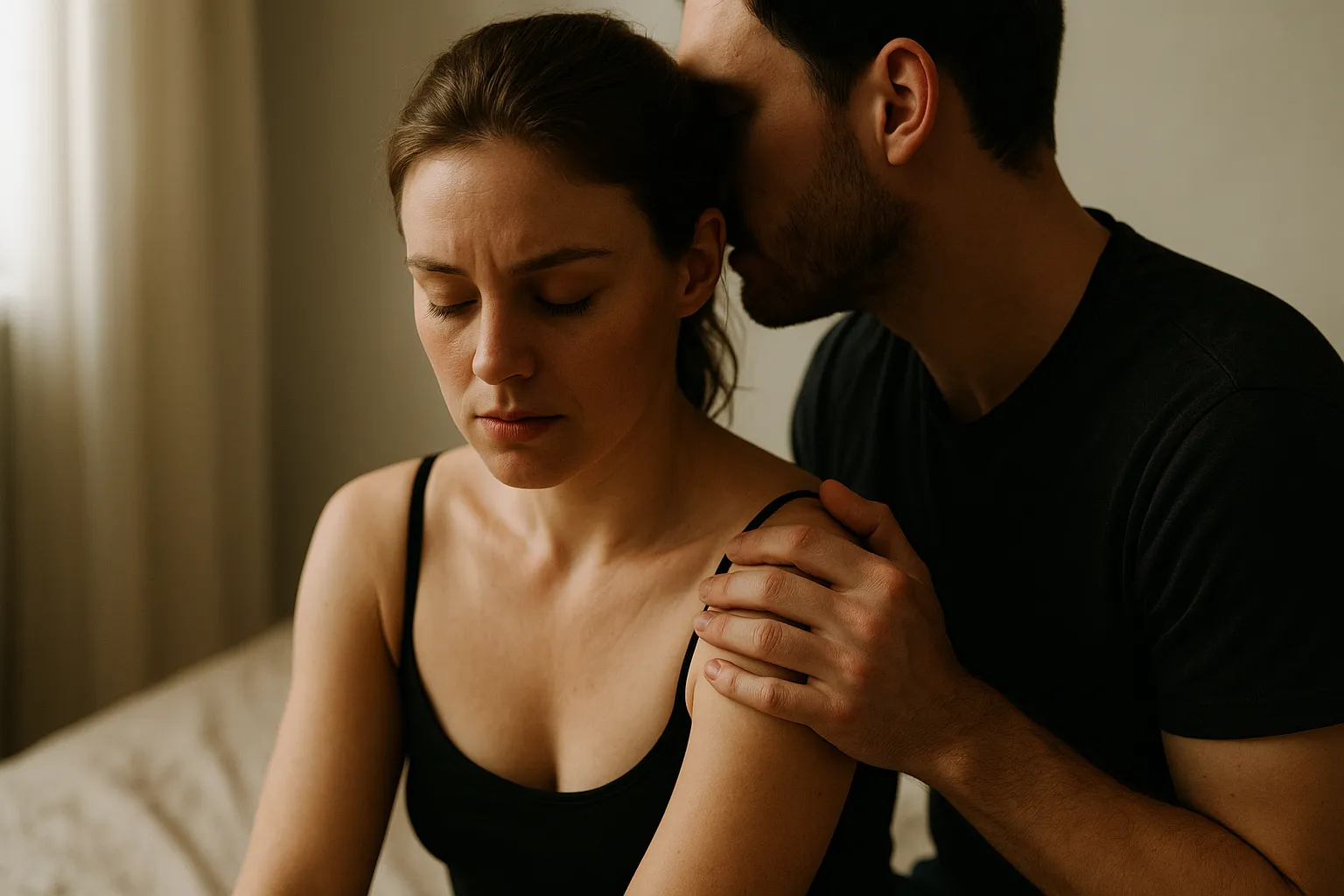
The Edge of Surrender
It started with a whisper.
A small, almost casual request spoken into the dimness of an afternoon room: “Endure this for me.” The words hung in the air, heavy and fragile at the same time. Not a command, not quite a plea — something in between.
I didn’t answer immediately. The air between us shifted, filled with the kind of silence that isn’t empty but charged. My heart beat faster, not from fear, but from recognition. Something deep in me understood what those words meant — the trust behind them, the risk inside them.
Desire, I’ve learned, is not always about pleasure. Sometimes it’s about surrender — not to another person, but to the moment itself. The willingness to step past comfort and into something unknown.
That’s where we met that day — at the edge of surrender.
The Language of Touch
There are conversations that don’t need words.
His fingertips traced the inside of my wrist, a line so light it felt imagined. I closed my eyes, and the world shrank to that single point of contact. My body knew this language before my mind did. Every gesture carried intention, every pause carried meaning.
There’s a rhythm to intimacy that only emerges when both people are listening. The inhale, the exhale, the waiting. We often think of connection as movement, but it’s just as much about stillness — about knowing when to stop, when to let silence speak for you.
He didn’t ask for control. He asked for trust. And in that request was something sacred — the idea that I could give, not because I had to, but because I chose to.
The Body as Conversation
I used to think pain and pleasure were opposites.
That one canceled the other out. But in truth, they’re siblings — different notes in the same song. Sometimes one bleeds into the other so seamlessly you can’t tell where the ache ends and the sweetness begins.
His hand on my skin was not cruel. It was deliberate. Every motion asked a question, and my body answered in tremors and breath. It wasn’t about dominance or submission, not really. It was about communication — about saying yes in a language that had no words.
I’ve always been drawn to the spaces where emotion meets sensation, where the physical becomes metaphor. Maybe that’s why I didn’t flinch. Maybe that’s why, when he whispered again, “Endure this for me,” I nodded.
Because what he was really asking was, Can you stay with me here — in this feeling, this moment, this rawness — without turning away?
And the truth is, I wanted to.
Trust Woven Through Skin
Trust is not built in grand declarations; it’s built in seconds — in the way someone touches you like you might break and believes you won’t.
When he moved closer, there was no rush. No performance. Just presence. I could feel his breath before his hands, and in that anticipation was everything — fear, desire, tenderness, courage.
It’s strange how something so physical can also feel deeply emotional. Every sound, every shift of light, every heartbeat became part of a shared pulse.
And beneath it all was the quiet knowing that I could stop it, that I had the power to pull away — and that power made the staying even more deliberate. That was the core of the trust between us: I stayed because I wanted to, not because I had to.
Desire without freedom is hunger. Desire with trust is devotion.
The Memory of Skin
There are moments that don’t fade — they live inside the body, replaying in fragments. The scent of the room. The faint hum of music in the background. The weight of breath against the back of my neck.
Afterward, I walked barefoot to the window. The glass was cool beneath my fingertips, the world outside still and indifferent. My reflection in the glass looked different somehow — softer, open, seen.
He stood behind me, quiet. There was no apology, no explanation, just presence. I turned to look at him, and in that glance was everything that didn’t need saying. We both knew this wasn’t about control or transgression. It was about release.
There’s something almost holy about that kind of vulnerability — the kind that requires both people to hold each other’s fragility with care.
When I think of that day now, I don’t think of the act itself. I think of the stillness after. The way silence filled the room like water. The way I exhaled without realizing I’d been holding my breath for so long.
What It Means to Endure
Endurance is often misunderstood.
People think it means suppression — holding back, tolerating, surviving. But endurance, in this sense, is something different. It’s staying present. It’s not looking away from what is intense, complicated, real.
To endure something with another person is to let yourself feel fully — the sharpness, the warmth, the ache — and to trust that you won’t drown in it. It’s about expanding your capacity for emotion, sensation, closeness.
That day, I realized how endurance can be a kind of love.
It’s the willingness to hold space for discomfort, for depth, for truth — both your own and someone else’s. It’s the courage to remain open when everything in you wants to retreat.
He wasn’t asking me to suffer; he was asking me to feel. To let myself be moved without resisting the movement.
The Afterglow of Understanding
Later, we didn’t talk much. We sat together on the edge of the bed, the sheets tangled between us, the light shifting slowly toward evening. There was no need to explain. What had passed between us wasn’t something that could be named easily.
He touched my hand — a simple, grounding touch. It felt like both apology and affirmation. I leaned into it, and for a moment, we were just two people breathing in rhythm, the intensity replaced by quiet affection.
Desire, I think, teaches you about the thresholds you didn’t know existed — not just in your body, but in your heart. It teaches you where you begin and where you can stretch beyond.
What we shared that day wasn’t about possession or pleasure. It was about trust. About surrendering to emotion without fear of being broken by it.
It was about seeing how far love can reach when it’s built on freedom.
The Unfinished Feeling
Even now, when I close my eyes, I can feel the trace of that moment — not as heat, but as resonance.
It left something behind — a pulse, a knowing, a reminder that endurance can be gentle, that surrender can coexist with strength.
What he asked me to endure wasn’t pain. It was presence.
To stay. To feel. To be seen.
And I did.
What lingered afterward was not shame or confusion, but clarity.
A quiet, steady understanding that sometimes the most intimate thing you can do is to meet another person at their edge — and stay there with them, unafraid.
That’s what I carry from that day: the echo of trust, the warmth of recognition, the unspoken promise that we both lived up to.
I endured — not because he asked, but because, in the truest sense, I wanted to.
The Quiet That Followed
Afterward, the world felt softer.
The light through the window seemed warmer, the air calmer, as if the universe itself had exhaled. It’s strange how intensity can leave behind peace — how something that once trembled with energy can dissolve into quiet understanding.
We moved slowly through the room, not speaking. There was no need for words. The silence wasn’t distance; it was fullness. A shared knowing. Our bodies had already said everything.
There’s a tenderness that comes after — not the passion of before, but something gentler. The kind of tenderness that belongs only to those who have crossed a threshold together and returned changed.
He brushed his thumb across my palm, tracing small circles. The gesture was grounding, almost reverent. It said you’re safe now, without needing to say anything at all.
And in that stillness, I realized: endurance isn’t the act itself. It’s what comes after — the space you make for meaning to arrive.
The Weight of Permission
We talk often about consent, but less about permission — the quiet, internal permission to feel everything that wants to surface.
That day, I had given him permission to touch, to guide, to lead. But more importantly, I had given myself permission to let go.
It’s easier to resist, to armor yourself in control. It’s harder to allow.
Allowing means you trust not only the other person but yourself — that you’ll know when to stop, when to breathe, when to stay open even as intensity rises.
I used to think surrender meant weakness. Now I know it’s the purest kind of strength.
It takes courage to stand inside sensation, emotion, vulnerability, and say, I will not run from this.
Permission, I think, is the most intimate gift we can offer — not our body, but our willingness.
Endurance as Connection
There are moments when endurance becomes communion.
When two people are so present that the boundaries between them blur. You stop thinking in separate pronouns — you, me — and start existing in shared language: we.
That’s what it felt like — a conversation made of breath, of touch, of stillness. Each movement said I’m here. Each pause said I trust you.
Enduring something together transforms it. It stops being about power and becomes about partnership. About knowing someone so deeply that you can hold their intensity without fear.
When I think about that day, it’s not the ache or the tension I remember most. It’s the connection. The way he looked at me — not as someone fragile or brave, but as someone whole.
To be seen that way, without distortion, is its own kind of healing.
Pain as Teacher
Pain has its own language, its own lessons.
For years, I avoided it — emotional pain, physical discomfort, the heaviness of grief. I thought endurance meant ignoring it, surviving it, waiting for it to pass. But this was different.
This was pain transformed — not inflicted, but invited. Not endured as punishment, but embraced as presence.
There was a rhythm to it, a rise and fall. It demanded focus, awareness, honesty. It asked, Can you stay here without flinching? Can you hold what hurts and still see beauty inside it?
That day, I learned that pain isn’t the opposite of love. It’s one of its languages. It reveals the edges of what we’re willing to feel. And sometimes, those edges are where the most profound connection happens.
We often talk about pleasure as expansion, but pain can expand you too — if you meet it with consciousness instead of fear.
The Tender Aftermath
Later that night, when the house was dark and quiet, I lay awake beside him.
I could still feel the echo of his touch — not as heat, but as vibration, a soft hum beneath my skin. My body was tired but alive, my mind quiet but aware.
He slept, one arm draped across me, fingers resting just below my collarbone. That small weight felt like an anchor, pulling me gently into the present.
I thought about how love changes form. How sometimes it speaks in laughter, sometimes in silence, sometimes in endurance. How each expression — even the ones that look strange from the outside — carries the same core message: I see you. I trust you. I’m here.
It occurred to me that what we shared wasn’t about control or pleasure at all. It was about being witnessed in my entirety — strength, fragility, longing, fear. And still being held.
There’s nothing more intimate than that.
The Mirror of Vulnerability
The next morning, I looked at myself in the mirror and saw something I hadn’t seen before: calm.
Not the brittle calm of detachment, but the kind that comes after release — the body no longer at war with itself. My reflection seemed softer, more certain, as though I’d stepped into a version of myself that had always been waiting.
Vulnerability, I realized, doesn’t make you smaller. It expands you.
To show yourself fully — trembling, uncertain, human — and to be met with care instead of judgment, rewires something deep inside.
It teaches you that intimacy isn’t about exposure. It’s about acceptance.
That morning, I smiled at my reflection — not out of pride, but out of recognition. The woman looking back was the same, and yet she wasn’t. She had endured, and in doing so, she had become more herself.
Love in the Afterlight
Endurance leaves traces — not scars, but reminders.
They live in the smallest gestures: the way I now breathe more deeply, the way I meet his gaze without looking away, the way quiet moments between us hum with unspoken understanding.
We don’t talk much about what happened that day. We don’t need to. It lingers in the way we move around each other — a subtle awareness that something inside us shifted.
It’s not about intensity anymore. It’s about presence. About knowing that what connects us isn’t the act, but the attention it demanded.
Love, I’ve learned, isn’t always gentle. But it’s always sacred when it’s built on respect.
The Meaning of Enduring
To endure doesn’t mean to suffer; it means to stay with what is real.
To sit inside the full complexity of feeling — without denial, without distraction. It means holding pain and pleasure in the same palm and knowing both have something to teach you.
When he asked, “Endure this for me,” what he was really asking was, Will you stay open with me — even here? Even when it’s hard, even when it’s deep, even when it reveals too much?
And I said yes.
Not just to him, but to life.
Because endurance, at its core, is an act of faith — faith that feeling deeply is worth the risk. That we can walk through intensity and come out the other side not diminished, but enlarged.
The Living After
Weeks have passed since that day, but its echo remains.
Not in memory alone, but in how I inhabit myself now — slower, fuller, more awake. I notice the texture of light on my skin, the sound of my own breathing, the subtle ache that says, you are alive.
He still touches me differently now — softer, but with the same knowing. Sometimes I catch him watching me, not with desire, but with quiet reverence. And I know he feels it too — the shift, the deepening.
Endurance has become our shared language.
Not the endurance of hardship, but the endurance of openness — the willingness to stay present even when it would be easier to retreat.
That’s what love is, I think. The constant choosing to stay awake in a world that tempts us to go numb.
And when I remember his words — Endure this for me — I no longer hear them as request or command.
I hear them as invitation.
To feel, to trust, to love without flinching.
And I keep saying yes.