
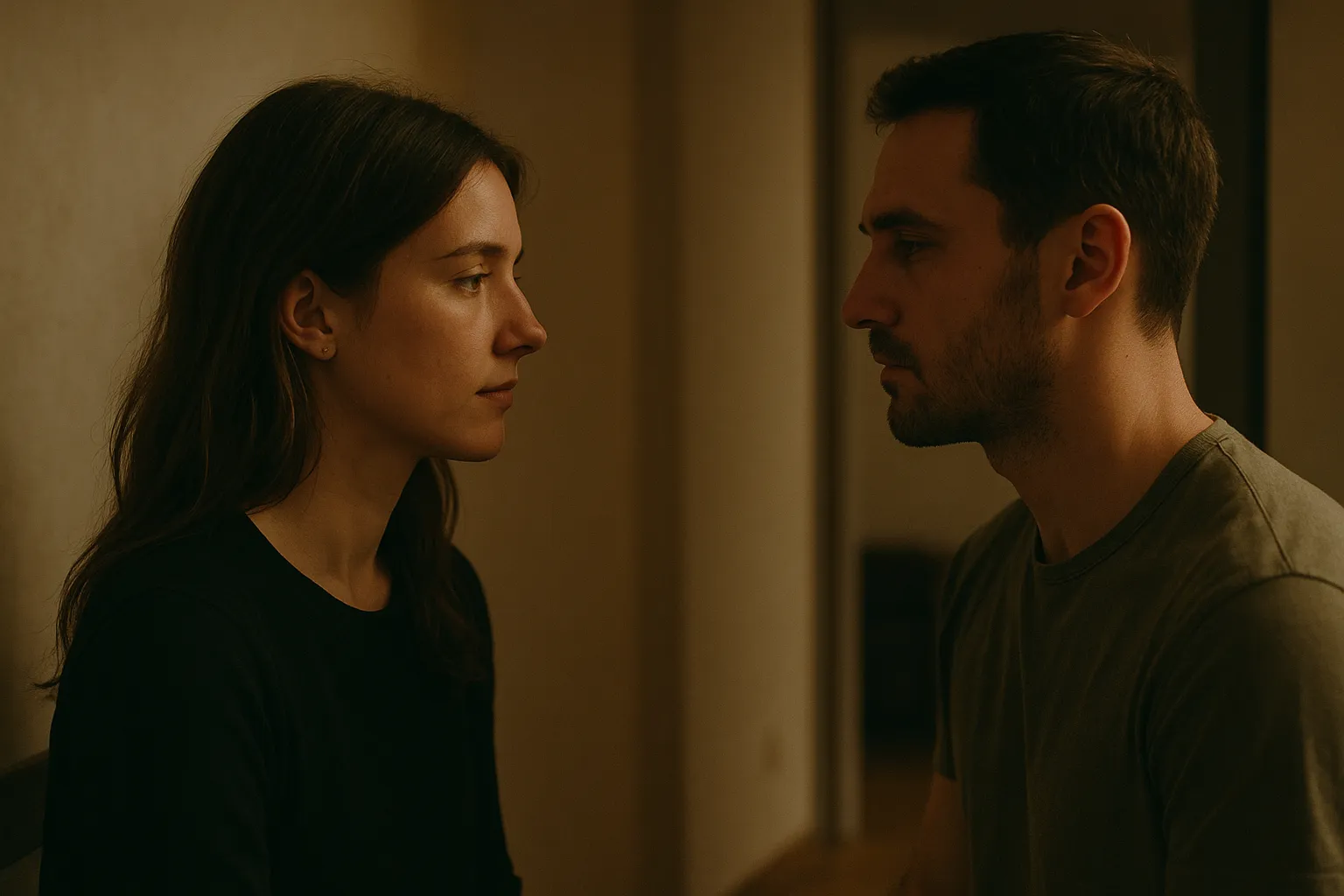
The Space Between Us
There are moments when desire lives not in touch, but in distance.
In the space between two breaths, two messages, two bodies separated by ordinary life — work, families, plans, commitments that don’t include each other. That’s where I often find it hiding, coiled like quiet energy waiting to unfurl.
Desire doesn’t always shout; sometimes it whispers. It waits in the air between conversations, in the way your name lingers in my mind long after we’ve stopped talking. I’ve come to understand that it’s not always about what happens, but what doesn’t. The anticipation, the hesitation, the restrained wanting that feels both tender and unbearable.
When we lived apart, desire was our third language. We spoke in half-sentences, unfinished thoughts, the occasional photograph that said more than words could. There was freedom in that space — the freedom of longing without expectation, of connection without routine. But there was also ache. A constant pulse of what if, threaded through the days like a secret heartbeat.
The Long-Distance Rhythm
People often think distance dulls desire, but I’ve found it can sharpen it — make every touch more deliberate, every word more charged. When you can’t reach someone easily, everything you do to bridge the gap becomes sacred.
I remember the rhythm of our meetings: the rush of seeing you after weeks apart, the quiet of shared mornings when we didn’t need to speak. Those moments felt suspended in time — fragments of life untouched by everything outside the room. We didn’t need declarations; the silence between us carried its own language.
There was something beautiful in the simplicity of it: the way a hand resting on mine could say everything words couldn’t, how your voice softened when you said my name. I used to wonder if it was love or something adjacent — something equally intimate but harder to name. But maybe that’s what desire truly is: not a question to answer, but a feeling to inhabit.
The Texture of Wanting
Desire, I’ve learned, is not always soft. It has edges — it can be raw, vulnerable, and uncomfortable.
It’s not just physical hunger; it’s a craving to be known, to be seen clearly without disguise.
There were nights I lay awake, not missing your body, but missing the feeling of being wanted. The warmth of belonging that flickered even when we were apart. It wasn’t neediness — it was recognition. A reminder that in a world full of noise and distraction, someone saw me and paused long enough to feel.
That pause — that awareness — is what I chase. Not the certainty of love, but the truth of connection. Desire is the spark that reminds me I’m still alive, still capable of being moved.
Sometimes I wonder if that’s why we return to it, again and again. Not because it promises forever, but because it reminds us what it means to be human.
Desire as Mirror
Desire shows you who you are when no one else is watching.
It strips away the practiced ease, the polite restraint, the quiet compromises we make in daily life. In its rawest form, it reveals hunger — for touch, for freedom, for self-expression.
There were moments when I felt more myself with you than anywhere else. Not because you completed me, but because you reflected me — the unguarded, unfiltered parts I’d learned to hide.
When you looked at me, it wasn’t admiration I saw. It was curiosity, recognition. You looked at me as if you were seeing something I’d forgotten existed. And for a brief time, I believed it too.
But desire, like reflection, changes with the light. When the moment passes, what remains is the echo — the quiet reminder that you can’t depend on someone else to hold your sense of self. Eventually, you have to become the mirror for your own longing.
The Weight of Presence
I remember the first time we stayed silent together — truly silent.
Not the silence of distance, but the silence of presence. It was a hotel room on a rainy afternoon, curtains drawn, the world outside reduced to muffled sound and gray light. We didn’t speak because we didn’t need to. Our breathing aligned, and for a few suspended seconds, everything else fell away.
Desire isn’t always urgent. Sometimes it’s slow, steady, patient. It lives in small gestures — the way you brushed my hair aside to see my face, the soft exhale when I touched your chest. These moments were so quiet they almost disappeared, but they’re the ones that return to me most often.
That day taught me something I’ve carried since: that intimacy isn’t measured by proximity, but by attention. The more present you are, the deeper the connection becomes.
When Desire Meets Reality
There’s a fragility in wanting what you can’t always have.
We built our connection in fragments — a few days here, a stolen evening there. We were always balancing what we felt with what was possible. It wasn’t lack of love that kept us apart, but the structure of our lives — the responsibilities, the people we cared for, the worlds we couldn’t easily merge.
Desire lived in the cracks between those worlds, thriving on what was left unsaid. But over time, the cracks began to widen. What had once felt like thrilling tension began to feel like a quiet ache.
I started wondering whether desire could exist without the distance that had shaped it. Could we still want each other in the everyday? When the hours stretched long and ordinary, would we still find magic in the mundane?
The truth is, I don’t know. Desire is an unpredictable guest — it stays when it wants to, leaves without warning, and sometimes returns when you least expect it.
Holding What Can’t Be Kept
Sometimes, the hardest part of desire is realizing it can’t always translate into permanence.
We think of desire as something to be fulfilled, completed, resolved. But maybe it’s meant to remain unfinished — a reminder that not everything precious has to last forever.
What we had, or maybe still have, doesn’t need to fit into definitions. It existed, it mattered, it shaped me. It taught me to pay attention to the smallest details — a breath, a glance, a shared silence that spoke louder than words.
Maybe that’s enough.
The Quiet After
Even now, when I catch the scent of a particular perfume, or hear a song we once played too loud, it brings you back — not the you I see in memory, but the feeling of you. That rare, electric stillness.
I don’t think desire ever really ends. It simply changes form.
It becomes part of you — woven into gestures, into awareness, into the way you touch others after. It softens, deepens, and finds new ways to express itself.
When Want Turns to Warmth
There came a time when desire stopped feeling like hunger and began to feel like warmth.
Not the blazing, breathless kind that once burned through every encounter, but something gentler — like sunlight filtering through curtains, steady and forgiving. The intensity faded, but what remained was depth. A quiet knowing that connection doesn’t need to be loud to be alive.
In the beginning, I thought desire needed to consume. That its proof was in urgency — the way hearts raced, the way time vanished. But over the years, I’ve learned that wanting someone can also mean stillness. It can mean comfort in silence, familiarity that feels like safety instead of absence.
There are evenings now when I sit alone, and the thought of you passes through my mind like a breeze through an open window — soft, familiar, not demanding to stay. That’s the gift of time. Desire no longer owns me. It visits, and I let it come and go.
The Afterglow of Memory
Some memories linger longer than they should.
Not out of pain, but because they hold light — a particular kind of brightness that you can’t recreate, only revisit. I still remember the curve of your smile when something amused you quietly, the way your eyes softened when I stopped talking mid-sentence. Those details are stitched into the fabric of my memory.
I used to think remembering meant I hadn’t moved on. But now I understand that memory is not a chain — it’s a bridge. It connects the person I was when we met with the person I’ve become since. The remembering itself is an act of gratitude, not longing.
Desire, in this softer form, doesn’t ask for return. It simply acknowledges that something once existed so vividly that it left a mark — not a wound, but an impression. And maybe that’s all it ever needed to do.
The Slow Transformation
There’s a tenderness in how desire changes shape.
What once demanded attention now teaches patience. The rush of newness gives way to the rhythm of familiarity, the awareness that love and longing are not opposites — they are echoes of the same song, played at different tempos.
We no longer meet in secret rooms or wait for messages that arrive at odd hours. The urgency has passed, replaced by something quieter, more sustainable. It’s not that the spark is gone — it’s that it’s found a steadier flame.
Desire, when it matures, stops shouting. It hums softly beneath everything — a low vibration that says, I remember who we were, and I honor who we’ve become.
Desire Without Possession
For a long time, I equated desire with ownership. I believed wanting someone meant holding them close, keeping them near, defining them as mine.
But true desire doesn’t bind — it frees.
It’s the kind that says, I want you to be happy, even if it’s not with me.
It’s the kind that sees beauty in someone’s independence, not threat.
You taught me that. There were days I wished for more — more time, more certainty, more belonging. But what we had existed precisely because it wasn’t bound by promises. It thrived in that fragile balance between intimacy and freedom.
There’s a purity in wanting someone without needing to control the outcome. It allows both people to stay whole, to grow, to change — without guilt or resentment.
Even now, when I think of you, it’s without ache. It’s with respect — for the honesty we managed, for the boundaries we learned, for the lessons we carried quietly into the rest of our lives.
The Desire to Be Seen
At its heart, desire is a longing to be seen.
Not admired or adored, but understood. To have someone look at you and see not the roles you play, but the person beneath them. That’s what we offered each other — moments of unfiltered recognition.
I didn’t realize how rare that was until it was gone. Most of the time, the world sees fragments of us — the professional self, the parent, the friend. But there, with you, I felt whole. Not because you gave me something I lacked, but because you allowed me to exist without performance.
Maybe that’s what I miss most — not the closeness, not even the passion, but the clarity. The feeling of being reflected back truthfully.
It’s that kind of seeing I now seek in other places — in art, in writing, in quiet mornings alone with my thoughts. It’s still desire, just transformed. The desire to stay real, even when no one is watching.
When Distance Becomes Home
Our relationship existed in motion — trains, planes, roads, messages crossing time zones. For years, I thought distance was what kept us fragile. Now I see it was what kept us pure.
Distance preserved our connection in a way closeness never could. It protected it from the ordinary, from the routines that dull the edges of intensity. The miles between us gave us space to imagine, to dream, to idealize. Maybe that’s what made it beautiful — the impossibility of it.
There’s a certain grace in unfulfilled love. It doesn’t decay; it simply lingers. It becomes a story that never had to survive the weight of daily life. And sometimes, stories like that are the ones that last the longest — not because they’re perfect, but because they remain untarnished by reality.
I don’t romanticize it anymore. I just acknowledge that some connections aren’t meant to be lived fully. They’re meant to be remembered, revisited, learned from.
Desire Turned Inward
There came a point when the wanting turned inward.
The longing I once directed at you began to find its way back to myself. I realized that the qualities I loved in you — your focus, your warmth, your attention — were reflections of what I’d been missing in me.
So I began the slow work of redirecting that energy.
Instead of waiting for someone else to make me feel alive, I started asking what makes me feel that way. I found desire again in art, in movement, in the pleasure of solitude.
That’s what I think maturity is — when desire no longer depends on another person to be awakened. It becomes a constant state of awareness, a deep curiosity about life itself.
What Remains
Desire doesn’t end; it evolves.
It becomes tenderness, gratitude, memory, peace. It becomes the soft smile when a song plays that once belonged to another time. It becomes the willingness to love again, differently, without fear.
What remains is not the ache of absence, but the richness of experience. Every moment we shared, every glance, every touch — they built something within me that stays.
When I look back, I don’t see regret. I see recognition — that we were exactly who we needed to be for each other, exactly when we needed it.
The Unfinished Feeling
Maybe desire was never meant to be resolved.
Maybe its beauty lies in its incompleteness — in the way it asks questions without demanding answers. There’s something infinite about that, something quietly comforting.
I still think of you sometimes, but not with longing. More like gratitude — for the way you reminded me that my heart is still capable of wonder.
And that, perhaps, is the truest form of desire: not possession, not permanence, but presence.
The knowing that even fleeting connections can awaken something lasting.
That sometimes, desire is enough — just as it is.