
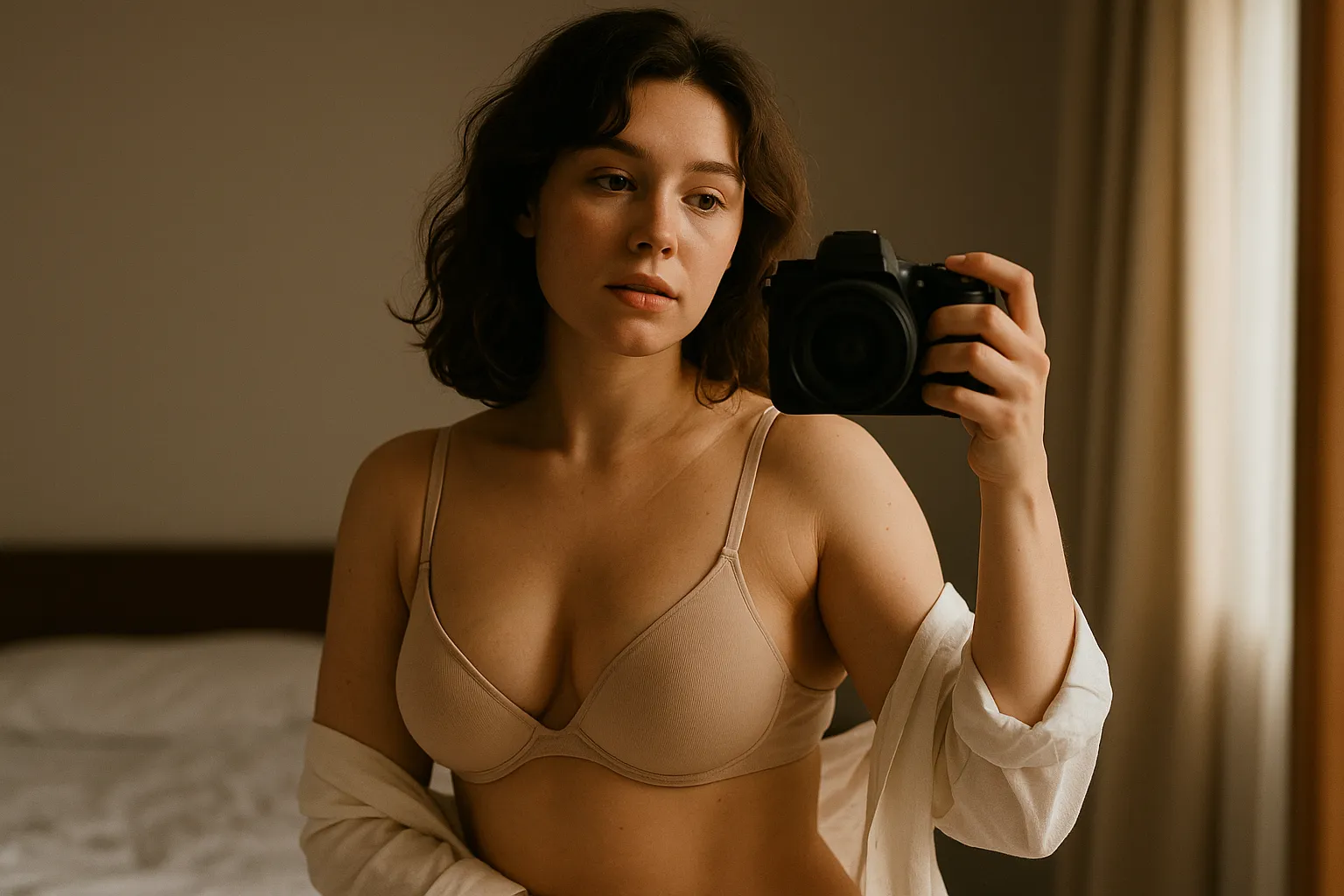
The First Click
It began as an experiment.
A quiet afternoon, a camera on the dresser, a mirror angled just so. I wasn’t trying to make art; I was trying to feel something. The shutter’s click startled me at first — loud, deliberate, final. It felt like both exposure and confession.
When I looked at the first photograph, I didn’t see beauty or flaw. I saw truth. A body caught between confidence and hesitation, curves softened by light, eyes half-curious, half-defiant. It wasn’t about seduction. It was about proof — proof that I existed beyond my own thoughts, beyond what others saw.
That single image became a doorway. I didn’t realize it then, but I was beginning to see myself again — not as a collection of imperfections, but as a landscape of feeling.
The Mirror and the Lens
There’s a difference between how the mirror sees you and how the camera does.
The mirror reflects; the camera reveals.
In the mirror, I posed. I adjusted. I tried to look the way I thought I should. But through the lens, I surrendered. The lens didn’t care about my stories — it caught the truth that leaked through the cracks.
I started taking self-portraits in the quiet hours — when the house was still, when the light was soft, when the air carried that electric stillness that feels like possibility. I would set the timer, step back, breathe, and wait for the click. Sometimes I’d smile, sometimes not. Sometimes I’d forget the camera was there, and those were always the photographs that stayed with me — the unguarded ones.
Desire lived in those moments, not as something directed outward, but as something returning to me.
Seeing Myself, Not Watching Myself
For years, I had been watching myself — analyzing, adjusting, judging.
The camera taught me how to see.
To see the way my body curved into light, how shadow could make vulnerability look powerful. To see the small details I once ignored — the line of a collarbone, the softness of a stomach, the way my hands always found something to hold.
Photography became less about capturing an image and more about reclaiming a gaze. For so long, I had learned to see myself through others’ eyes — filtered through desire, expectation, criticism. But now, the gaze was mine.
I wasn’t performing anymore. I was participating.
In each image, I met a version of myself that had been waiting quietly for permission to exist.
Desire as Self-Dialogue
Desire is often misunderstood as something that depends on another person.
But what if it’s really a conversation between you and your own aliveness?
When I began photographing myself, I realized how much I’d outsourced desire — how often I needed to be wanted to feel worthy. Each picture became a small rebellion against that conditioning. It was my way of saying, I can want myself.
The process was intimate in the purest sense — not sexual, though sometimes sensual. It was the intimacy of attention. The act of noticing. The courage to linger.
Desire, when turned inward, is creative energy. It’s not about possession; it’s about presence. Each photograph became a meditation on that — a moment of stillness where I could see myself both as subject and witness.
And in those seconds of alignment, something shifted. I stopped waiting to be chosen.
The Body as Language
Our bodies speak in ways words cannot.
Mine speaks through curve, gesture, breath. Through the angle of a shoulder or the slow turning of my head toward light.
I began to understand that desire isn’t about perfection — it’s about expression. It’s the moment a body says, I am here. I am alive. I am feeling this.
Some days I took photos clothed, others bare. The difference wasn’t about exposure — it was about honesty. The more I stripped away, literally or metaphorically, the more the images felt like truth.
I learned to trust the lens to hold that truth gently. It never lied, but it never judged either. It simply offered reflection — the kind that invites rather than condemns.
In this language of bodies and light, I found fluency I hadn’t known I possessed.
The Courage to Look
There’s bravery in looking at yourself — truly looking.
It’s easier to critique, to glance and move on, to keep distance from your own image. But to linger, to study your own face, your own form, without armor — that’s an act of vulnerability and power combined.
Some days, it felt uncomfortable. I’d scroll through the photos and feel a familiar ache of self-doubt. The old voices returned: too much, not enough, too visible, too plain. But I stayed with them. I didn’t delete. I didn’t retreat.
Over time, I noticed the shift. My first reaction was no longer judgment — it was recognition. I started to see beyond the surface. I saw emotion, story, life.
And slowly, I began to love what I saw — not because it was flawless, but because it was mine.
Desire Without Performance
We live in a world that teaches women to perform desire — to make it palatable, controlled, shaped for an audience.
But self-photography taught me the opposite. Desire isn’t a performance. It’s an instinct.
When I moved in front of the lens, I wasn’t trying to seduce. I was exploring how desire feels from the inside out. Sometimes it was soft, sometimes defiant, sometimes tender enough to make me tear up.
The more I let go of control, the more real it became. The camera became a companion, not an observer — a tool for translating what lived inside me into something visible.
I realized that desire, like art, thrives in truth. And truth doesn’t always look composed. Sometimes it looks raw, unfiltered, and deeply human.
Capturing the Invisible
There’s always something beneath the surface of every image — something unseen but undeniably present. That’s what I wanted to capture.
Not just a body, but the pulse beneath it. Not just a look, but a feeling.
Every photograph became a small act of documentation — of change, of becoming, of remembering. I wasn’t photographing how I looked; I was photographing how I felt.
Desire, it turns out, isn’t always visible. It’s an atmosphere. A texture. A tension in the air between what’s shown and what’s withheld.
I started noticing that the most powerful images weren’t the ones where I tried the hardest — they were the accidents. The blurred ones. The ones where I wasn’t ready. Because that’s where truth lives: in the in-between moments, when you stop performing and start simply being.
Becoming the Image
With time, I stopped seeing the photographs as representations. They weren’t reflections anymore — they were extensions.
I wasn’t just in the image; I was the image.
Each frame felt like both surrender and reclamation — letting myself be seen without asking for permission.
I began to understand that capturing desire isn’t about freezing it in time. It’s about witnessing its movement — the way it changes from moment to moment, day to day.
And in capturing that movement, I realized something profound: desire isn’t something I need to chase or earn. It’s already within me — waiting to be noticed, to be held, to be expressed.
Desire as Creation
Desire has become my art.
Not in the way the world defines it — not lust, not hunger, not the glossy performance of wanting — but in its purest form: creation. Every time I lift the camera, I’m not trying to capture how I look; I’m trying to capture how it feels to be alive inside this body.
It’s a collaboration between motion and stillness. Between the part of me that wants to reveal and the part that longs to stay hidden. Each photo becomes a dialogue between those two selves — the seen and the unseen, the bold and the uncertain.
Some images hum with quiet vulnerability. Others blaze with defiance. But all of them hold truth.
Desire, I’ve realized, is not just physical — it’s creative energy in disguise. It asks, What if you stopped waiting to be seen and started showing yourself?
That question has changed everything.
The Alchemy of Light
Photography taught me to worship light.
How it transforms everything it touches, how it softens edges and sharpens emotion. Light is honest but forgiving — it reveals without cruelty.
I learned to chase it around the house like a secret lover. Early morning light — cool, pale, forgiving. Evening light — golden, heavy, full of memory. I learned how it can trace a body like a confession, how it can make the ordinary shimmer with intimacy.
There’s a particular kind of light that lives between shadows — that gray, uncertain glow just before dusk. That’s the light that feels truest to me. The one that knows what it is to both hide and reveal.
In that half-light, I find courage. The courage to show what isn’t polished, to honor the in-between states — not quite strong, not quite fragile, but both at once.
Maybe that’s what desire really is: the light that finds you when you finally stop hiding.
From Self-Image to Self-Intimacy
When I first started photographing myself, I thought I was documenting how I looked. But somewhere along the way, it became about how I relate to myself.
The camera became less a mirror and more a bridge.
Through the lens, I discovered a new kind of intimacy — one that didn’t depend on approval or touch. It was the intimacy of understanding, of seeing my whole self without editing the parts I’d been taught to conceal.
The process became ritualistic: setting the scene, finding the light, breathing before the shutter. Each session felt like a conversation — a moment of reconnection with a self I had neglected.
I began to see patterns — how tension gathered in my shoulders, how softness appeared when I exhaled. These weren’t flaws or poses; they were language. The body, speaking in gestures, telling me where I still held pain and where I had found peace.
What began as photography became healing. Each image was a reminder: I don’t need to earn the right to see myself with tenderness.
The Unlearning
To see yourself clearly, you must unlearn everything you’ve been taught about beauty.
You must stop thinking of your body as an object and start remembering it as an experience.
The unlearning is slow. It happens when you stop apologizing for softness, when you stop trying to make your reflection smaller. It happens the day you take a photo that doesn’t flatter you — and keep it anyway. Because even in that angle, that shadow, that imperfection, there’s honesty.
I had to unlearn the belief that desire depends on someone else’s gaze. I had to unlearn that aging means fading. I had to unlearn that my worth was tied to symmetry, smoothness, youth.
The lens, unlike the mirror, doesn’t care about narratives. It shows you what is. And in learning to accept what is, I found a new kind of peace — the kind that doesn’t require anyone’s permission.
The Feminine Gaze
There’s a shift that happens when women reclaim their own gaze.
For generations, we’ve been taught that our beauty, our sensuality, our bodies, exist to be witnessed — evaluated, desired, consumed. But when we turn the lens toward ourselves, everything changes.
The power dynamic dissolves. We are no longer subjects — we become authors.
I started to notice how different my photos felt from the images I’d seen before. They weren’t about provocation. They weren’t designed for approval. They were about presence. About belonging to myself.
When I looked at the images later, I didn’t see vanity. I saw reclamation.
I saw softness where I once saw weakness. I saw depth where I once saw flaw.
The feminine gaze is not about objectifying; it’s about inhabiting.
It’s about saying, I am not something to look at. I am something to feel with.
When Desire Meets Art
The deeper I went into this process, the more I realized that art and desire share a heartbeat. Both begin with curiosity — a spark that says, what if I touch this, try this, explore this? Both require vulnerability. Both require surrender.
Each photograph I took wasn’t just an image; it was evidence. Evidence of permission, of return, of becoming.
Sometimes, I’d review the photos and feel a rush of emotion — not pride, not shame, just recognition. That’s me. Not the version the world expects. Not the curated one. Just me — flawed, expressive, alive.
Desire became my muse, not because it made me feel wanted, but because it made me feel awake. It reminded me that creativity is another form of sensuality — the act of bringing something into being simply because you feel it too strongly to keep inside.
The Sacred Ordinary
One day, I realized I no longer needed to pose.
The act of photographing myself had become so natural that the camera simply blended into my daily life. I’d catch glimpses of myself in passing reflections — cooking, stretching, reading — and think, this too is worthy of being captured.
Desire no longer needed to be framed in intensity. It lived in the ordinary now — in morning light on my collarbone, in the quiet curve of a smile, in the way my body moved without trying to impress anyone.
That’s when I understood: I wasn’t documenting beauty. I was documenting being.
The sacredness of the ordinary is what makes it eternal.
Desire, too, is ordinary — not because it’s small, but because it’s human. It belongs to everyone who has ever looked in the mirror and whispered, I want to feel alive again.
The Gift of Being Seen
There’s power in showing your own vulnerability before anyone else can use it against you.
That’s what these images gave me — the power of self-ownership.
By capturing my own desire, I became my own witness. I stopped waiting for someone to validate what I felt. The images told me: you are both muse and maker, both subject and storyteller.
Now, when I look at them, I don’t see someone trying to be beautiful. I see someone learning to stay open. Someone learning to live without apology.
Desire doesn’t ask for attention anymore. It asks for honesty. And I give it that — through words, through light, through stillness.
Becoming the Art
I once thought art was something separate from life. Now I know it’s the same thing.
The moment I stopped performing and started existing, everything became art — the way I moved, the way I rested, the way I looked at myself with compassion.
Every photograph, every moment, is part of a larger story — a story about remembering that desire isn’t something to prove or possess. It’s something to live.
And in that realization, the act of capturing desire became something else entirely.
It became love.